
SAP Datasphere
OUR SOLUTUIONS
SAP Datasphere
What Is SAP Datasphere?
SAP Datasphere, previously called Data Warehouse Cloud, is a flexible cloud platform that helps businesses build, manage, and use data warehouses. It gives companies the right tools to easily manage, connect, and analyze their data using the power of the cloud for better data management.
How Your Business Will Benefit From SAP Datasphere
Cost efficiency
Scalability
Performance
Ease of management
Integration
Security
SAP Datasphere Features That Will Help You Achieve These Benefits
-
Centralized data repository
SAP Datasphere acts as a central place to store and manage data. It allows different departments and systems to access and share information easily, removing data silos and improving teamwork.
-
Connection to SAP Data with Business Context
SAP Datasphere helps businesses automatically understand SAP data within its business context by easily connecting to SAP applications. This seamless integration keeps important business meaning and relationships in the data, making it easier for teams to analyze and use information effectively.
-
Unified data management
This platform helps organizations bring together data from different internal and external sources across the company. This integrated approach gives a complete view of the business’s operations, customers, and performance, making it easier to make informed decisions.
-
Integrated Data Marketplace
This platform helps organizations bring together data from different internal and external sources across the company. This integrated approach gives a complete view of the business’s operations, customers, and performance, making it easier to make informed decisions.
-
Advanced analytics
SAP Datasphere offers built-in analytics and data visualization tools, allowing users to create interactive dashboards and reports. This makes it easy for business users to analyze complex data on their own, without always needing help from IT or data teams. With these tools, businesses can quickly uncover insights and make better decisions based on real-time information.
-
Real-time insights
SAP Datasphere can process and analyze data instantly or almost instantly. This lets businesses make informed decisions using the most current data, so they can respond quickly to changes and opportunities.
-
Collaboration
The platform supports teamwork by allowing people to work together on data modeling and analysis. Teams can share insights, co-create reports and dashboards, and collaborate easily on data projects to drive better results.
-
Innovations
SAP regularly updates and improves SAP Datasphere with new features and capabilities. This ensures businesses always have access to the latest tools and advancements in data management and analytics.
-
Semantic Business Modeling
This feature empowers users to create their own data models easily while keeping governance and IT control in place. Users can connect their own data, share it securely, and perform analytics independently without impacting other users. This balance promotes user freedom and data security within the organization.
-
Re-use & Extend SAP BW Investments
Saptix helps you make the most of your existing SAP BW data structures, transformations, customizations, and team skills. You can quickly extend your SAP BW investments to the public cloud, reusing what you already have. This saves time, protects your previous investments, and lets your team work with familiar tools while benefiting from a modern cloud platform for greater flexibility and innovation.
-
Business Content
Saptix provides ready-made data models and easy-to-understand views of SAP ERP data using CDS views and Service APIs. It also uses SAP’s business knowledge and insights from ecosystem partners to help transform data effectively. This makes it simple for businesses to access and work with reliable, high-quality data.
-
Choice and Openness
Saptix supports multiple cloud platforms and offers open interfaces, giving you the freedom to choose your preferred modeling environments, analysis tools, and languages like SQL, Python, and Jupyter notebooks. This flexibility suits everyone—from business analysts to data scientists and developers—making it easier to work with data in the way that fits your team best.
SAP Datasphere vs. SAP Data Warehouse Cloud: What Is the Difference?
SAP Datasphere is the next-generation version of SAP Data Warehouse Cloud. It keeps all the powerful features of its predecessor but adds more advanced tools for data management, analytics, and collaboration.
SAP Datasphere improves performance and scalability, allowing businesses to handle larger data volumes and work faster. It also supports smooth integration with many different data sources and tools.
A key focus of SAP Datasphere is teamwork—it makes it easier for teams to collaborate on data modeling and analysis projects. It also introduces new features like data integration, data cataloging, and semantic modeling to help businesses manage their data even better.
SAP is continuously improving Datasphere by adding new functions and updates, making it a modern, cutting-edge platform for data management and analytics.
Possible Use Cases of SAP Datasphere
Enterprise-wide Data Consolidation
SAP Datasphere centralizes data from different departments and sources into one unified repository. This makes it easier to analyze data thoroughly and make better business decisions.
Collaborative Business Intelligence
SAP Datasphere supports teamwork by enabling teams to work together on data modeling and analysis. They can share insights and jointly create reports and dashboards to drive better outcomes.
Data-driven Decision-making
By handling complex queries and large datasets, SAP Datasphere helps businesses uncover valuable insights that guide smart, strategic decisions.
Enhanced Customer Experience
With smooth integration to SAP applications and other data sources, SAP Datasphere gives businesses a full view of customer interactions, enabling more personalized and responsive customer services.
Efficient Resource Utilization
SAP Datasphere’s scalable, pay-as-you-go model helps organizations use resources effectively by adjusting capacity as needed, avoiding large upfront costs.
Data Monetization
Using SAP Datasphere’s Data Marketplace, businesses can find new ways to generate revenue by securely sharing or selling data to trusted partners.
Predictive Analytics
With broad data access and smart analytics tools, SAP Datasphere supports predictive modeling that helps businesses anticipate future trends and plan ahead effectively.
SAP Datasphere Architecture
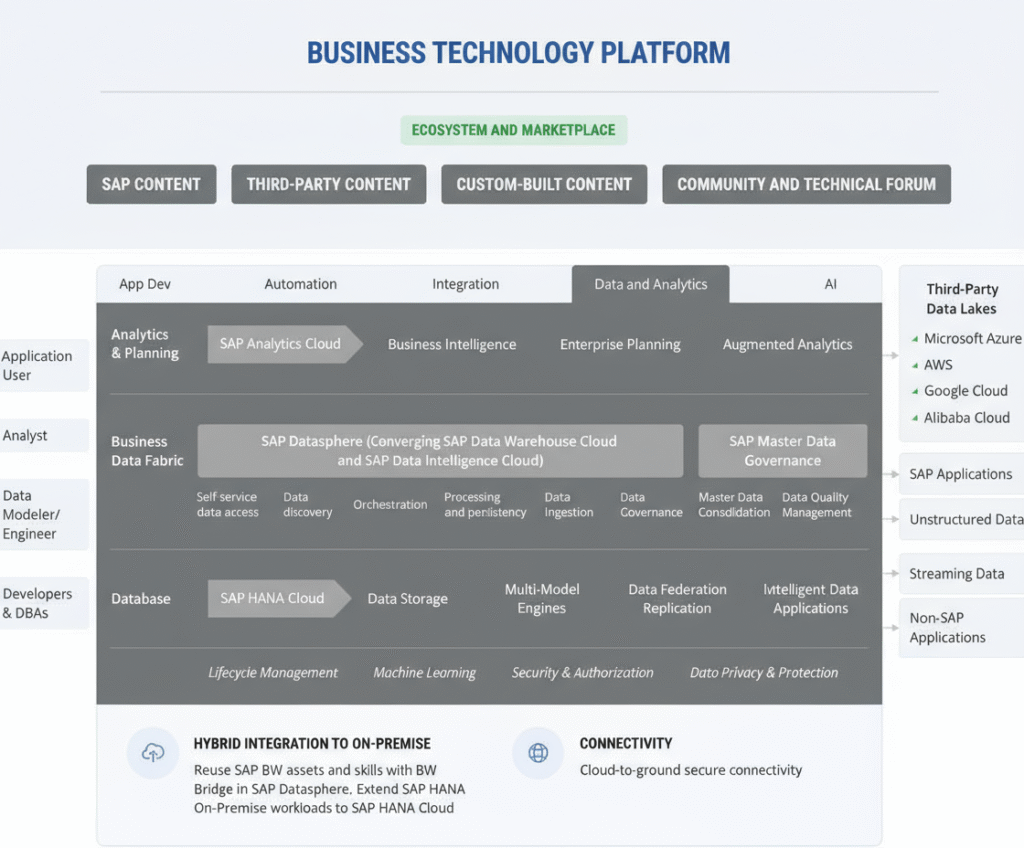
Explore the Possibilities of SAP Datasphere Integration




Frequently Asked Questions
-
What is SAP Datasphere?
SAP Datasphere is a cloud-based data warehouse solution that helps businesses easily connect, manage, and analyze data from different sources in one place. Key Features of SAP Datasphere Data integration Data modeling Advanced analytics Data governance Team collaboration Real-time processing Scalability
-
How is SAP Datasphere different from traditional on-premise data warehouses?
Unlike traditional systems that require hardware and complex setups, SAP Datasphere is cloud-based. This makes it more scalable, faster to deploy, and easier for teams to collaborate.
-
How does SAP Datasphere support data integration?
It provides built-in connectors to different databases, applications, and systems, allowing businesses to quickly bring data together from both SAP and non-SAP sources.
-
Can I use my existing data sources with SAP Datasphere?
Yes. SAP Datasphere is designed to connect seamlessly with both SAP and third-party data sources.
-
What analytics options does SAP Datasphere offer?
It includes tools for creating reports, dashboards, and visualizations. Users can also run SQL queries and explore data for deeper insights.
-
Does SAP Datasphere support real-time data processing?
Yes. It allows real-time or near real-time data processing so businesses can make decisions using the latest information.
-
How does SAP Datasphere handle security and compliance?
It uses encryption, access controls, and compliance certifications to protect sensitive data and meet regulatory standards.
-
Can multiple users work together in SAP Datasphere?
Yes. Teams can collaborate on data models, share insights, and work together on reports within the same platform.
-
Do I need coding skills to create reports and dashboards?
No. SAP Datasphere comes with an easy-to-use interface, enabling business users to build reports and dashboards without advanced coding knowledge.
-
How is data governance managed in SAP Datasphere?
It includes data lineage, quality checks, and metadata management to ensure accuracy, reliability, and compliance.
-
Is SAP Datasphere suitable for all business sizes?
Yes. It is designed to support both small companies and large enterprises.
-
Is there a trial version available?
Yes. SAP often provides free trials or demo versions so businesses can test SAP Datasphere before adopting it.
-
How is pricing decided?
Pricing follows a subscription model, usually based on usage, storage, and features required.
-
Can SAP Datasphere integrate with other SAP solutions?
Yes. It integrates smoothly with other SAP products, creating a complete data and analytics ecosystem.